Events
Planning & Advice
Before choosing a venue or a supplier, it helps to know who does what in a luxury event, how the budget is set and which permits are needed.
What sets a luxury event apart from an ordinary one
A luxury event isn't defined by a bigger budget but by the level of care: a venue that isn't generic, suppliers chosen one by one for that specific occasion, solutions you won't find in a standard package. It's the difference between renting a hall and building an experience that can't be replicated anywhere else, with attention to the details no one notices until they work and everyone notices if something goes wrong. It applies to a wedding, but also to a corporate gala dinner, a product launch or a significant private party.
The roles in event planning
Under the same umbrella there are different roles, and it's worth knowing which one you're hiring before signing a contract.
- Wedding planner: coordinates a wedding as a whole, from the budget to directing the day. The couple's single point of contact.
- Event planner: does the same job for events of every kind (corporate, galas, private parties), with a focus on logistics, timing and the outcome for whoever commissions them.
- Wedding or event designer (or stylist): handles only the aesthetic side, palette, flowers, staging, table setup. Doesn't manage suppliers or timing.
- Wedding or event coordinator (day-of coordinator): comes in only in the final weeks and runs the day itself, not the planning beforehand.
- Event agency: a structure that brings together several skills (planning, design, technical production, communication), with more than one contact and its own insurance cover.
- PCO (Professional Congress Organiser): specialises in conferences, managing registrations, rooms, speakers and accreditation.
- DMC (Destination Management Company): works in a specific area and handles logistics, transfers, excursions and services for events with guests arriving from elsewhere.
- Banqueting manager: the venue's or caterer's person who coordinates the spaces, the service and the timing of the reception.
These skills can sit in the same person or agency, but they need to be spelled out in the contract: “full planning” doesn't mean the same thing to everyone.
What an agency or a planner actually does, from start to finish
Whatever the type of event, the work of whoever coordinates it always follows the same sequence. It's worth knowing so you understand what you're paying for and where a professional really makes the difference.
Brief, objective and budget
It starts from what the event has to achieve and how much you want to spend. The planner turns those two pieces of information into a realistic budget broken down by category and says from the outset what isn't possible with that figure.
Venue search and site inspection
The planner proposes venues that fit the style, capacity and logistics, then arranges the site visits and runs them with a technical eye: real capacity, indoor backup plan, access, services, restrictions on timing and volume.
Supplier selection and contracts
For each category they propose two or three trusted names, gather and compare the quotes like for like, and put everything in writing. This is where the planner's network of relationships counts most.
Design and production
Design, setup, content, technical rehearsals, a setup and breakdown plan with times. The planner turns the idea into an operational plan with names and timings.
Paperwork and permits
Documents for the ceremony or authorisations for the event, SIAE, safety clearance, public liability insurance. These steps have their own lead times, often weeks.
Directing the day and the review
The planner is on site from setup to breakdown, keeps to time and handles the unexpected. After the event, where relevant, they gather the data to see whether the objective was met.
For anyone organising an event in Italy from a distance, with no local contacts and perhaps in another language, this role isn't an extra: it's the condition for the event to work.
The site inspection: the step you can't skip
Photos and videos of a venue convey the atmosphere but not the details that decide whether an event works: whether the kitchen is fitted or has to be brought in, where guests' cars arrive and park, how much power there is, how much noise carries from outside, whether the bad-weather backup is a real room or a marquee to be put up, and what the restrictions on music and timing are. For an event in a historic residence, these things change everything. People organising from a distance usually delegate the first round of visits to the planner and make a single, focused trip for the shortlist: that's when a venue is confirmed or ruled out, not before.
How the budget is set (and why it comes first)
The budget is set at the start and kept up to date throughout. Only once a spending ceiling is fixed does it make sense to evaluate venues and suppliers: doing it afterwards, perhaps having already seen or booked a venue, is the most common cause of choices made under pressure and costs that get away from you. The budget should be split by category (venue, catering, flowers or setup, music or technical production, photography, communication, logistics, security) with a margin for the unexpected. There's no reliable average figure: it depends on the venue, the guest count, the level of the suppliers and the time of year.
Supplier contracts: what should always be there
Every serious supplier offers a written contract. Before signing, check that it includes: a precise description of the service (spaces, times, quantities), what's included and what's extra, delivery times, payment terms and deposits, penalties for cancellation or changes, and the supplier's insurance cover. On quotes, it's always worth comparing more than one like for like: not to pick the cheapest, but to understand the market and what's reasonable to ask for. A supplier who refuses to put the details in writing is already a first warning sign.
Permits, authorisations and insurance: an overview
An event in a historic venue almost always involves an authorisation side. In short: SIAE for live or recorded music; INPS employment clearance to employ performers and technicians; a public entertainment licence and SCIA for events open to the public (a private, invitation-only event in an authorised venue usually doesn't need one); a commission check when stages or structures are built or certain capacities are exceeded; a safety management plan for large numbers; and public liability insurance for the event, for which insurers ask in advance for the date, venue, number of attendees and planned activities. In practice the agency or the venue handles this, but these are steps with their own lead times, some of them weeks, to factor in from the start.
How long it takes and how the process is structured
The timeline depends on the format: a high-end wedding or a large corporate event with production takes 12 to 18 months; a convention or a gala dinner 3 to 6 months; a simple internal event just a few weeks. The logic, though, is always the same: first you fix the objective and the budget, then you lock in the venue, then you choose the key suppliers (the most in-demand ones, like photographers and caterers, run out well in advance), then you build the programme for the day, and finally you handle the direction on the day itself. Doing the steps out of order, or starting too late, means choosing from what's left rather than from the best options.
Articles
publication order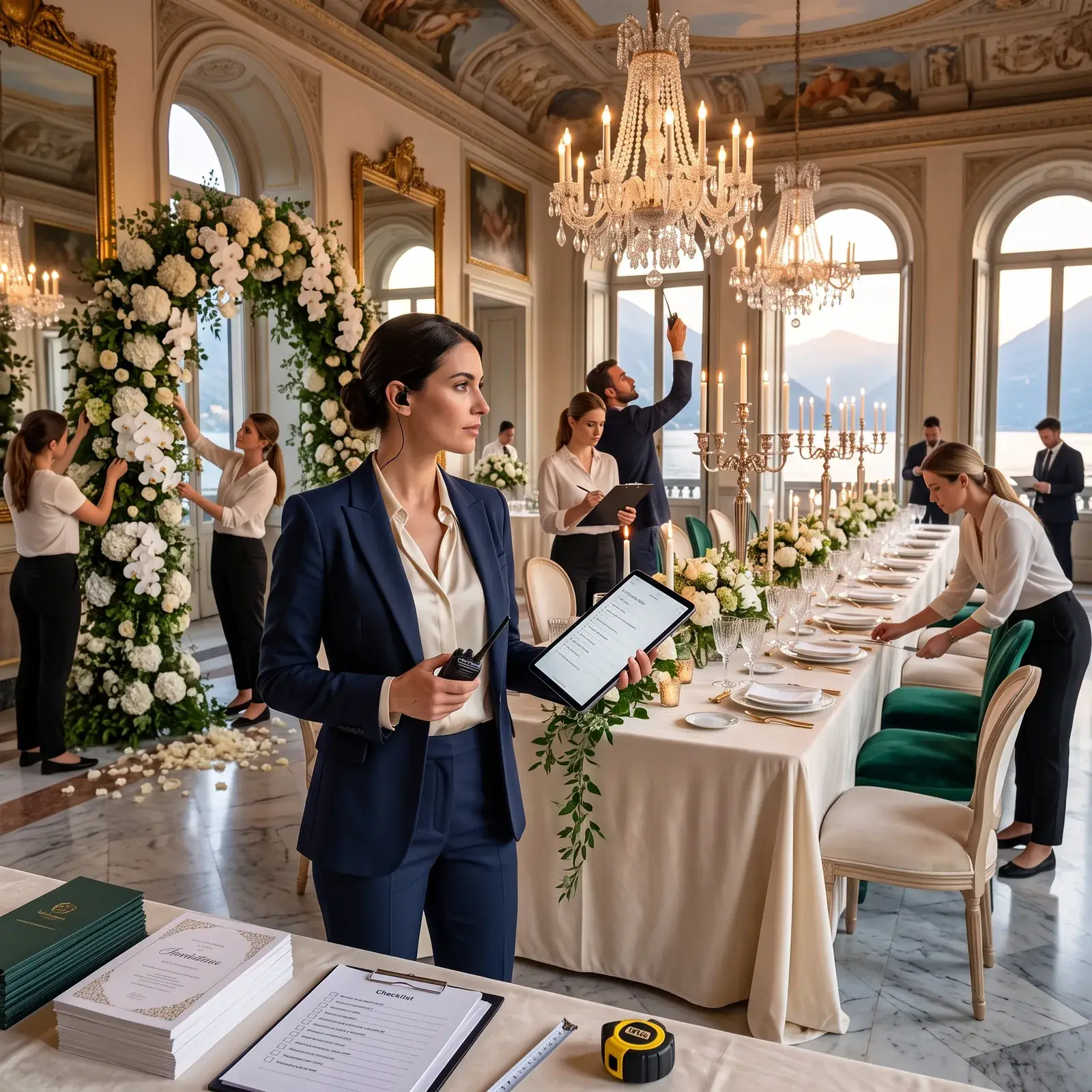
Tell us about your event
Planning an event in this area? Tell me what you have in mind: I'll try to put you in touch with someone who can build a proposal tailored to you, not from a catalogue. No newsletter, no use of your data for generic marketing.